
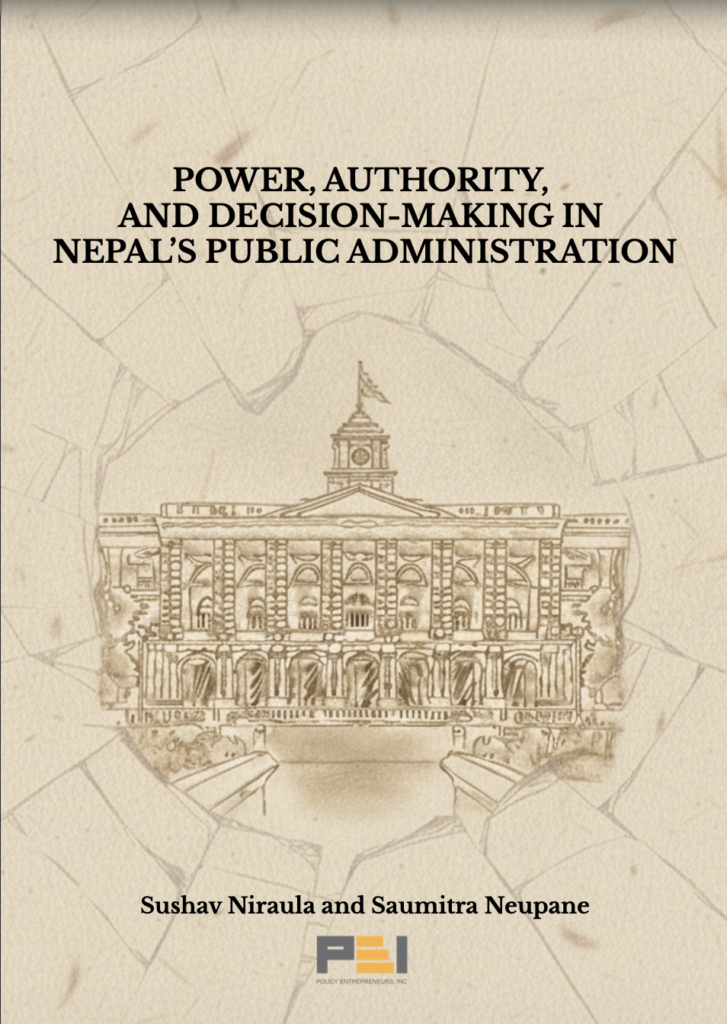
Power, Authority, and Decision-Making in Nepal’s Public Administration
Author: Sushav Niraula and Saumitra Neupane
Year of Publication: 2026
About the Study:
To most people — even those who regularly interact with government — Nepal’s bureaucracy resembles a black box. Its inner workings are shaped by procedures, hierarchies, and unspoken conventions that resist easy explanation from the outside. This study is an attempt to look inside.
Published by Policy Entrepreneurs, Inc. (PEI), this research examines bureaucratic power, authority, and decision-making in Nepal’s public administration system. Drawing on 127 key informant interviews, 17 focus group discussions, and field visits across four provinces, it offers one of the most detailed accounts of how Nepal’s civil service actually functions — not as it is designed on paper, but as it is lived and navigated by its thousands of agents.
Published by Policy Entrepreneurs, Inc. (PEI), this research examines bureaucratic power, authority, and decision-making in Nepal’s public administration system. Drawing on 127 key informant interviews, 17 focus group discussions, and field visits across four provinces, it offers one of the most detailed accounts of how Nepal’s civil service actually functions — not as it is designed on paper, but as it is lived and navigated by its thousands of agents.
The study explores bureaucratic power at three levels: the individual civil servant, specific bureaucratic cadres, and the institution as a whole. It traces how the civil service evolved from an instrument of monarchical authority to an institution capable of forming and realising its own will — and how that transformation has shaped Nepal’s governance in the decades since.
Key themes include:
• The formal and informal sources of bureaucratic power — from rank, portfolio, and service group to political connections, trade union affiliation, and regional identity
• The politics of transfers and promotions, and how these personnel decisions have become arenas of negotiation between political actors and civil servants
• How bureaucrats actively shape — not just implement — public policy, including at the drafting and legislative stages
• The dynamics of Nepal’s federal transition, examined through the Employee Adjustment Act 2018 and the contested Federal Civil Service Bill
• Why subnational governments emerged from federalisation under-resourced and structurally imbalanced — and what that means for the future of governance reform
Key themes include:
• The formal and informal sources of bureaucratic power — from rank, portfolio, and service group to political connections, trade union affiliation, and regional identity
• The politics of transfers and promotions, and how these personnel decisions have become arenas of negotiation between political actors and civil servants
• How bureaucrats actively shape — not just implement — public policy, including at the drafting and legislative stages
• The dynamics of Nepal’s federal transition, examined through the Employee Adjustment Act 2018 and the contested Federal Civil Service Bill
• Why subnational governments emerged from federalisation under-resourced and structurally imbalanced — and what that means for the future of governance reform
This study is intended for researchers, reform-minded practitioners, and anyone interested in questions of governance reform, bureaucratic power, and decision-making in Nepal and comparable federal contexts. Whether you work within the civil service, study public administration, or seek to advocate for reform, this research offers an analytical framework and empirical grounding that is rarely available for a system as opaque as Nepal’s.